

How Does a Handgun Cleaning Kit Support Long-Term Firearm Care Across Different Calibers?
A handgun cleaning kit is a dedicated maintenance solution designed to remove fouling, residue, and contaminants that accumulate during regular firearm use. Proper maintenance is a foundational requirement for accuracy consistency, mechanical reliability, and service life preservation.
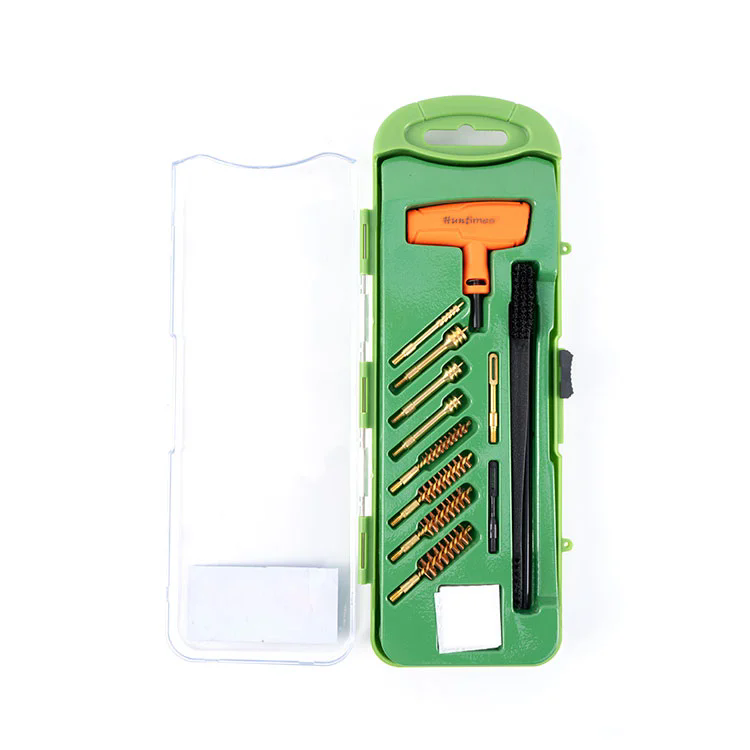
The central focus is to explain how a handgun cleaning kit functions as a system rather than a collection of isolated tools. By aligning component materials, dimensional tolerances, and storage configuration, a professional-grade kit supports repeatable cleaning outcomes while minimizing the risk of barrel damage or component wear. Attention is also given to compatibility with common handgun calibers and to the practical considerations that influence purchasing decisions in mature markets.
Typical Product Parameters and Specifications
| Parameter Category | Specification Details |
|---|---|
| Supported Calibers | .22 / .357 / .38 / 9mm / .40 / .45 |
| Cleaning Rod Type | Sectional steel or brass rod with threaded joints |
| Bore Brushes | Phosphor bronze brushes matched to each caliber |
| Jags & Tips | Brass jag tips and slotted patch holders |
| Patches | Cotton cleaning patches, lint-controlled |
| Accessories | Utility nylon brush, microfiber cloth |
| Storage Case | Molded polymer or fabric zip case with internal slots |
| Portability | Compact form factor suitable for range or home use |
| Corrosion Resistance | Treated metal components to resist moisture exposure |
These parameters reflect a configuration commonly expected by distributors and end users seeking consistency with industry norms and local regulatory environments.
How Does a Handgun Cleaning Kit Address Multi-Caliber Maintenance Needs?
Handgun owners frequently operate more than one caliber platform, particularly in markets where sport shooting, personal defense, and training overlap. A properly configured handgun cleaning kit addresses this reality by incorporating interchangeable components that maintain dimensional accuracy across bore sizes.
Cleaning rods and brush threads are manufactured to standardized tolerances to prevent wobble during bore passes. This reduces uneven contact pressure, which can otherwise accelerate rifling wear. Phosphor bronze brushes are selected due to their balance between fouling removal efficiency and barrel steel safety. Unlike harder alloys, these brushes flex under load and maintain consistent surface contact without scoring.
Patch systems are equally critical. Slotted tips and jag heads must align with patch thickness to ensure uniform bore contact. Oversized patches increase friction and risk rod flex, while undersized patches compromise residue removal. A complete handgun cleaning kit resolves this by supplying caliber-matched consumables rather than universal substitutes.
From an operational perspective, consolidated storage supports workflow efficiency. When all components are organized in a single case, maintenance routines become repeatable and less error-prone. This is particularly relevant for institutional users such as training facilities, where consistency across multiple firearms is a baseline requirement.
How Is Material Selection in a Handgun Cleaning Kit Aligned With Durability Expectations?
Material engineering plays a decisive role in long-term kit performance. Cleaning rods, for example, are often manufactured from brass or coated steel. Brass offers inherent softness relative to barrel steel, reducing abrasion risk, while coated steel provides higher tensile strength for stubborn fouling removal. The choice between these materials reflects a balance between safety margin and mechanical resilience.
Brush construction similarly reflects functional priorities. Phosphor bronze resists deformation under repeated use and maintains bristle geometry longer than standard copper alloys. Nylon utility brushes complement this by allowing external component cleaning without surface scratching, particularly on polymer frames or coated slides.
Storage case materials are selected to protect against moisture ingress and mechanical shock. Molded polymer cases offer structural rigidity, while fabric cases emphasize portability and weight reduction. Internal slotting and elastic retention systems prevent component collision, which can dull brush ends or deform rod threads over time.
These material considerations ensure that a handgun cleaning kit remains serviceable over extended ownership cycles, aligning with expectations in regions where consumers prioritize long-term value and replacement part availability.
How Do Usage Patterns and Market Expectations Shape Handgun Cleaning Kit Design?
Changing ownership demographics and usage patterns influence how handgun cleaning kits are configured. Increased participation in recreational shooting and training programs has elevated expectations for ease of use and clear component differentiation. Color-coded brush bases or labeled compartments reduce selection errors, particularly for newer users.
Portability is another defining factor. Compact kits that fit range bags or vehicle storage compartments support on-site maintenance between sessions. This reduces downtime and supports consistent firearm condition management.
Regulatory and cultural factors also shape design priorities. In markets with strict transport and storage norms, discrete and durable cases are favored. In contrast, regions with high training frequency emphasize rapid access and modular layouts.
These considerations demonstrate that a handgun cleaning kit is not static hardware but an evolving maintenance platform that reflects broader industry and consumer trends without compromising core functional requirements.
Common Questions About Handgun Cleaning Kits
Q: How often should a handgun cleaning kit be used for routine maintenance?
A: Cleaning frequency depends on usage volume, ammunition type, and environmental exposure. For regular range use, cleaning after each session is widely recommended to remove carbon and primer residue before it hardens. For firearms stored for extended periods, periodic inspection and light cleaning help prevent corrosion and lubricant degradation.
Q: How does a caliber-specific brush improve cleaning effectiveness compared to a universal brush?
A: A caliber-specific brush matches bore diameter precisely, ensuring full contact with rifling surfaces. This improves fouling removal efficiency while maintaining even pressure distribution. Universal brushes may underperform due to inconsistent contact or excessive stiffness, which can increase wear risk.
Conclusion and Brand Reference
A handgun cleaning kit serves as a structured maintenance system that supports firearm reliability, accuracy retention, and component longevity. By aligning material selection, dimensional precision, and organized storage, such a kit addresses the practical demands of multi-caliber ownership and diverse usage environments. Market expectations continue to emphasize durability, portability, and clarity of configuration, reinforcing the role of standardized, well-engineered kits in responsible firearm care.
Shanghai Hunting Speed Industry&Trade Co., Ltd. focuses on supplying handgun cleaning kits that meet these expectations through controlled manufacturing processes and specification-driven design. For further product information, customization options, or distribution inquiries, interested parties are encouraged to contact us directly to discuss specific requirements and cooperation opportunities.